
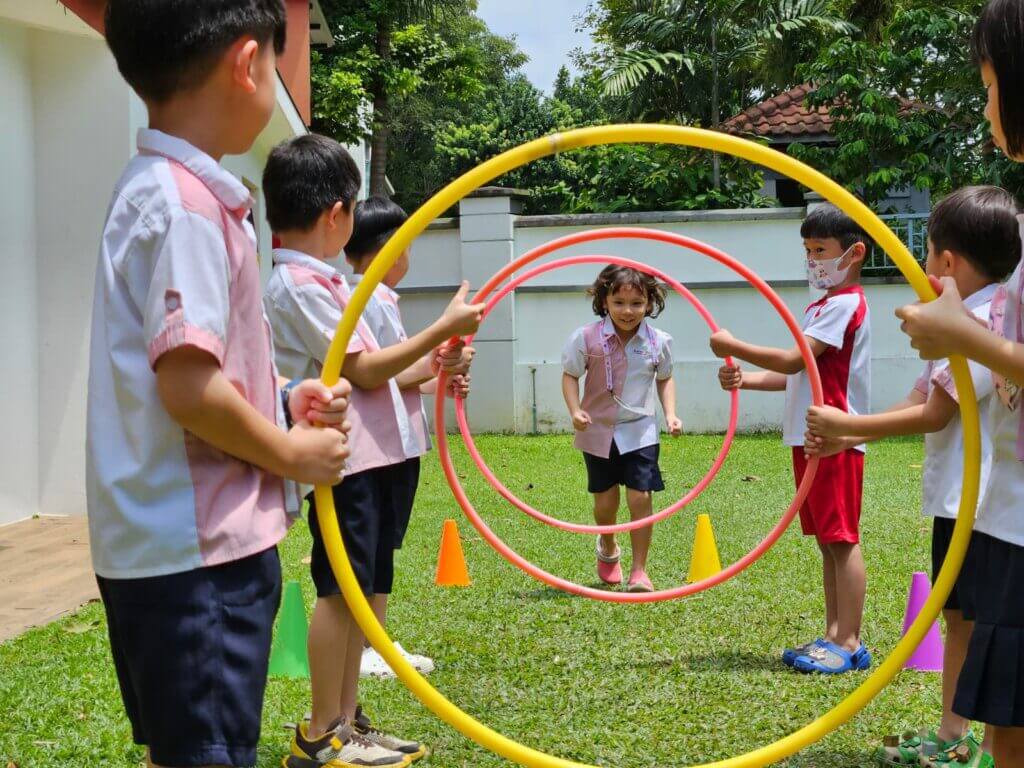
Spending time outdoors improves a child’s physical strength, coordination, motor skills, and immune system, especially during preschool. Beyond physical advantages, it gives children the chance to explore the natural environment around them and also serves as an ideal learning environment for the holistic development of children.
In line with the Nurturing Early Learners (NEL) Framework by the Early Childhood Development Agency (ECDA), many preschools and childcare in Singapore incorporate various outdoor learning experiences as part of their curriculum for young children. Here are some benefits of outdoor play and how we incorporate it into our childcare curriculum:
Promote Overall Health and Well-Being
Being outdoors gives children more opportunities to be physically active, improves their motor skills, strengthens their immune system and reduces the risk of myopia. Physically active children are also likely to have healthier weight and better bone density through improved strength and greater exposure to sunlight and vitamin D. Other than physical benefits, outdoor experiences also improve children’s mental and emotional well-being as the outdoors have a calming effect and positively influences children’s level of stress, attention and focus.
Boost Brain Development and Cognitive Functions
Outdoor experiences provide opportunities to develop cognitive functions like creativity, imagination, critical thinking, problem-solving, and concentration. In an open outdoor space, children get the chance to engage in imaginative play and navigate through scenarios, giving them opportunities to assess situations, strategize and solve problems, thus nurturing their cognitive skills.
Improve Self-Esteem, Confidence, and Interpersonal Skills
Collaborative outdoor activities, such as building a fort or organizing a group game, require children to navigate social dynamics. Negotiating roles, sharing resources, and communicating effectively with peers are inherent aspects of outdoor play that foster interpersonal skills. Outdoor play also involves an element of risk, which encourages children to test their boundaries and builds confidence in children as they overcome these challenges.
Develop Conceptual Knowledge and Skills
The outdoor environment serves as a vibrant real-world canvas for children to engage in exploratory activities that develop children’s learning in areas like mathematics, language, and scientific processes. Natural elements like rocks, sticks and leaves become tangible math tools that children can spontaneously count, sort, and arrange to understand basic mathematical concepts. Engaging in collaborative outdoor activities becomes a catalyst for language development and fosters skills such as observation, prediction, and inference, laying the groundwork for a scientific mindset.
How Raffles Kidz Incorporate Outdoor Experiences in the Childcare Curriculum
At our childcare centres, we go beyond the traditional playground setup. While each of our childcare centres has its own outdoor playground, some of our centres boast bicycle tracks, allowing our preschoolers to pedal their way to physical fitness, while some centres provide water play, a refreshing twist to outdoor fun.
Our Fun with Fitness curriculum focuses on goal-oriented play for optimal motor skill development. A typical lesson or topic would stretch across a few days, comprising different types of activities that children will be guided into accomplishing sequentially. Mixed play makes it possible to develop motor elements such as strength, durability, agility, speed, balance, and coordination. For example, children learn to skip and side shuffle, then use those skills to move through an obstacle course.
With the aim to develop confident learners at Raffles Kidz Singapore, our comprehensive curriculum caters to the holistic development of the whole child through purposeful play, self-exploration and inquiry-based learning. Book a tour with us today to learn more about our childcare centres!