
Nurturing strong numeracy skills in children during their preschool years is crucial for their academic success and cognitive development. Early exposure to mathematical concepts not only builds a solid foundation for more complex mathematical learning but also enhances critical thinking, problem-solving abilities, and logical reasoning.
As stated in Singapore’s Nurturing Early Learners (NEL) Framework, “Development of numeracy concepts and skills involves helping children know and use the concepts and skills in ways that relationships and connections are formed and then apply them meaningfully in their daily experiences.” Here are five engaging methods to that encourage the learning of mathematical concepts and skills:
- Counting Through Play:
Encourage counting through playful activities that capture your child’s imagination. Use everyday objects like toys, fruits, or blocks to practise counting. For example, have your child count how many stuffed animals they have or how many blocks they can stack. Incorporate counting into games like hide-and-seek by counting aloud while searching for hidden objects.
- Maths in Motion:
Integrate numeracy into physical activities to make learning dynamic and interactive. Create a hopscotch board with numbers and encourage your child to jump to each number while counting aloud. Play “Simon Says” with numbers, such as “Simon says, jump three times” or “Simon says, touch five toes.” This not only reinforces counting but also develops gross motor skills.
- Shape Scavenger Hunt:
Turn shape recognition into a fun adventure by organising a shape scavenger hunt around your home or backyard. Create a list of shapes for your child to find, such as circles (plates), squares (windows), or triangles (pizza slices). As they discover each shape, encourage them to identify and name it. This activity helps develop spatial awareness and geometric understanding.
- Cooking Together:
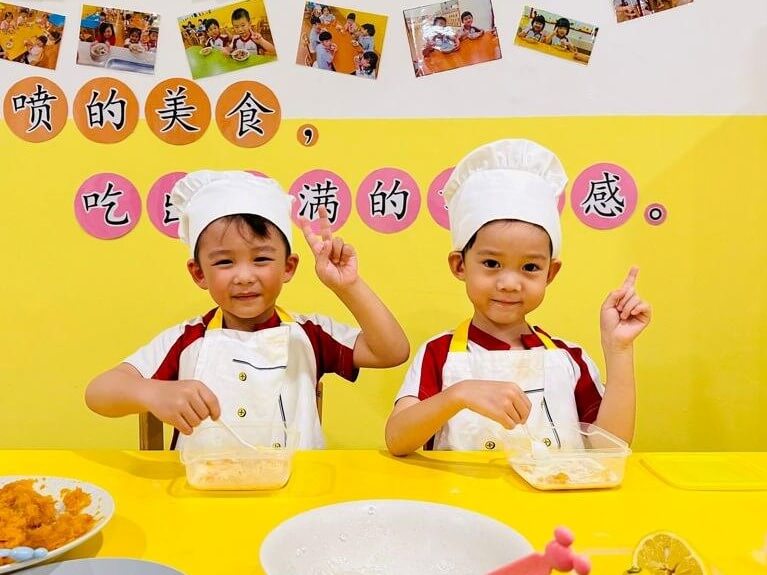
Involve your child in the kitchen to explore mathematical concepts while cooking or baking. Use measuring cups and spoons to introduce the concept of volume and fractions. Ask them to help count ingredients, such as measuring out three cups of flour or adding four eggs to the batter. Cooking provides hands-on experience with real-life Maths applications and enhances mathematical vocabulary.
- Maths Story Time:
Utilise storybooks as a springboard for mathematical discussions and activities. Choose books that incorporate counting, patterns, or shapes into the storyline. After reading, engage your child in related Maths activities, such as counting the characters on each page or identifying shapes within the illustrations. Encourage them to create their own maths-themed stories or drawings afterward.
Conclusion
Incorporating numeracy activities into your child’s daily routine not only fosters a love for Maths but also strengthens their foundational numeracy skills in a fun and interactive way.
At Raffles Kidz Singapore, we provide our preschool children with diverse opportunities to develop their mathematical abilities through an inquiry-based/Montessori approach and all-inclusive enrichment activities in cooking, art, music and speech and drama. Learn more about our child care programmes and find a Raffles Kidz preschool near you today!