
Key Takeaways
- Not all teaching approaches are applied the same way in practice, even if they share similar labels.
- Observing how learning happens daily gives more insight than relying on curriculum descriptions alone.
- A balanced preschool places equal emphasis on structure, exploration, and meaningful teacher guidance.
Part 1 – Introduction
1.1. Choosing a Preschool: Why Teaching Approach Matters
Choosing a preschool often begins with practical considerations such as distance, fees, and availability. But beyond convenience, many parents also wonder whether the teaching approach will suit their child’s personality, learning pace, confidence level, and language development needs. Yet, as many parents soon realise, what shapes a child’s daily experience most deeply lies in the different teaching approaches used in the classroom.
These approaches influence how children learn, how they interact with others, and how they build confidence in new situations. Even subtle differences in how lessons are guided or how play is structured can shape a child’s attitude towards learning over time.
Parents exploring preschools in Singapore are often presented with a wide range of curriculum labels. Terms such as inquiry-based, Montessori-inspired, or play-based appear frequently, but understanding how these translate into daily classroom experiences is far more important than the label itself.
In Singapore, all programmes are guided by the Nurturing Early Learners Framework, which provides a common structure across different teaching approaches. Within this framework, schools interpret and apply their chosen methods in ways that reflect their philosophy, environment, and educator training.
| Learning Area | What It Focuses On | What It Looks Like in Practice |
|---|---|---|
| Aesthetics and Creative Expression | Creativity, imagination and self-expression | Art, music, movement and open-ended creative activities |
| Discovery of the World | Curiosity about surroundings and how things work | Exploring nature, simple experiments, asking questions |
| Language and Literacy | Communication, reading and early writing skills | Storytelling, conversations, phonics, vocabulary building |
| Motor Skills Development | Physical coordination and movement | Outdoor play, fine motor tasks, balance and coordination |
| Numeracy | Early mathematical thinking and problem solving | Counting, patterns, shapes and basic number concepts |
| Social and Emotional Development | Relationships, self-awareness and behaviour | Group activities, sharing, emotional regulation and routines |
Part 2 – Understanding Teaching Approaches in Singapore Preschools

2.1. Popular Teaching Approaches Adopted by Preschools in Singapore
Most preschools in Singapore use a mix of different teaching approaches rather than a single method. Within the national framework, these approaches guide how children learn, build independence, and develop both social-emotional skills and academic readiness, allowing schools to meet developmental expectations while adapting to local learning needs and cultural priorities.
It is also common for schools to interpret these teaching approaches in their own way. Two preschools may both describe themselves as inquiry-based or Montessori-inspired, yet their daily practices can look quite different depending on how teachers are trained and how the curriculum is structured.
For parents, recognising these different teaching approaches helps make sense of how schools present their programmes. It becomes easier to look beyond labels and focus on what actually happens in the classroom, such as how teachers guide activities or how children engage with materials.
Rather than asking which method is best, it is more useful to consider how consistently and thoughtfully different teaching approaches are applied. When visiting preschools, parents can ask practical questions such as: “What is the daily timetable? What happens if my child cannot keep up with the curriculum?” These insights allow families to compare preschools meaningfully and choose an environment that supports both learning and emotional development.
2.2. Montessori and Inquiry-Based Learning in Singapore Preschools
Montessori Method
The Montessori method is one of the most widely recognised influences among different teaching approaches, valued for its emphasis on independence, focus, and hands-on learning. In Montessori-based learning approaches, children engage with carefully designed materials that allow them to explore concepts through touch, movement, repetition, and self-correction.
Rather than relying heavily on direct instruction, children are encouraged to work at their own pace and build confidence through purposeful activity. This does not mean the classroom is unstructured. A strong Montessori-inspired environment is usually calm, organised, and predictable, with clear routines and carefully prepared materials.
In Singapore, many preschools adapt Montessori principles to suit local expectations. This often means blending independence with active teacher guidance, rather than following a strictly traditional model. Teachers observe closely, step in when needed, and help children connect hands-on exploration with language, numeracy, and social development.
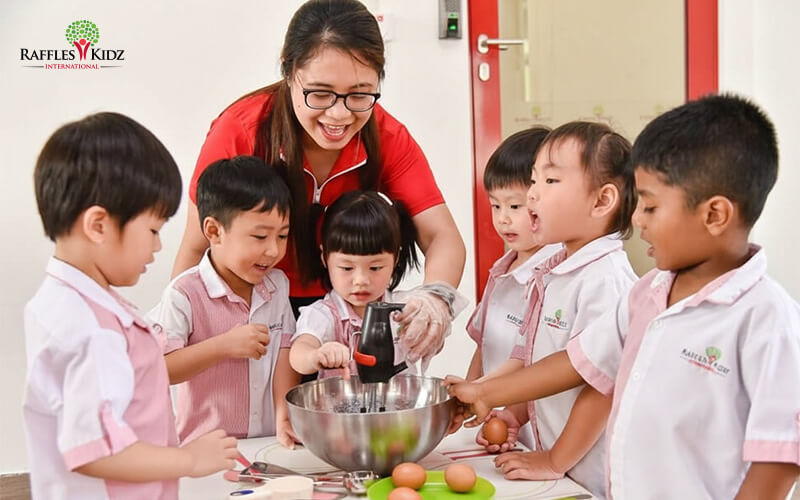
At Raffles Kidz International, Montessori principles are integrated with inquiry-based learning to create a balanced approach. Children are given opportunities to explore independently, while teachers provide guidance, questioning, and structure to support deeper understanding.
Inquiry-Based Learning
Inquiry-based learning focuses on curiosity, exploration, questioning, and guided discovery. In this approach, children are encouraged to ask questions, share ideas, observe closely, and investigate topics through meaningful activities.
Rather than simply presenting information, teachers design experiences that prompt thinking. A simple activity might involve observing objects, discussing patterns, comparing materials, predicting outcomes, or exploring cause and effect. These experiences help children develop reasoning skills, language confidence, and a stronger sense of curiosity.
In practice, inquiry-based learning in Singapore is carefully structured. Teachers set clear learning intentions and guide discussions so that exploration leads to meaningful understanding. For example, when exploring the topic of plants, a teacher may begin by asking children what plants need to grow, then guide them to observe real plants, compare differences, and test their ideas through simple activities.
This is where teacher-child interaction patterns matter. Effective inquiry-based learning depends on how teachers listen, question, extend ideas, and respond to children’s thinking. The strongest classrooms do not simply allow children to explore freely; they use thoughtful guidance to turn curiosity into learning.
2.3. Other Common Preschool Teaching Approaches
Beyond Montessori and inquiry-based methods, parents will often come across several other different teaching approaches, each offering a distinct way of supporting early learning.
The Reggio Emilia approach, for instance, places strong emphasis on child-led exploration and collaboration. Learning is often shaped around children’s interests, with teachers guiding projects and documenting progress over time. This creates a reflective environment where children’s ideas are taken seriously.
Play-based learning is another widely adopted model. Here, structured play is used intentionally to support communication, social interaction, and problem-solving. While it may appear informal, well-designed play experiences are carefully planned to align with developmental goals.
Waldorf Steiner education introduces a more rhythm-based approach, where storytelling, creative arts, and consistent routines form the foundation of learning. Academic concepts are introduced more gradually, allowing children to develop imagination and emotional awareness first.
Some preschools also draw from the Multiple Intelligences framework, recognising that children learn in different ways. Activities are designed to engage various strengths, from language and logic to movement and music.
To make these different teaching approaches easier to compare, here is a quick reference guide:
| Approach | Core Principle | Typical Classroom Feel | Best for Children Who… |
|---|---|---|---|
| Reggio Emmilia | Child-led exploration and collaborative learning | Open-ended, discussion-based, projected-focused | Enjoy expressing ideas, asking questions, and working with others |
| Play-Based Learning | Learning through guided play and interaction | Active, engaging with structured play stations | Learn best through hands-on activities and social interaction |
| Waldorf Steiner | Rhythm, creativity, and experiential learning | Calm, routine-driven, with strong emphasis on storytelling and arts | Benefit from predictable routines and imaginative exploration |
| Multiple Intelligences | Recognising different learning strengths | Varied activities across movement, language, logic, and music | Show diverse interests and strengths beyond traditional academics |
2.4. Why the Same Teaching Approach Can Look Different Across Preschools
One reason parents may find preschool selection confusing is that the same teaching approach can look very different from one centre to another. A school may describe itself as Montessori-inspired, inquiry-based, or play-based, but the actual classroom experience depends on how the approach is implemented.
Several factors influence this:
- Teacher training and experience
- Classroom pacing and learning progression
- Teacher-child interaction patterns
- Class size and individual attention
- Learning environments and facilities
- How bilingual learning is integrated
- Whether activities are structured, exploratory, or a balance of both
For example, a Montessori-inspired classroom may feel calm and independent in one school, but more teacher-led in another. An inquiry-based classroom may encourage meaningful questioning in one setting, while another may simply use project themes without deeper discussion.
This is why parents should carefully observe the daily environment. The quality of implementation matters more than the curriculum label. A strong preschool should be able to explain not only what approach it uses, but how that approach supports children’s independence, confidence, language development, emotional growth, and school readiness.
Part 3 – How to Choose the Right Preschool for Your Child

3.1. Teaching Approach and Curriculum Fit
Every child responds differently to structure, independence, exploration, and teacher guidance. When evaluating preschool curriculum in Singapore, parents should look beyond the name of the different teaching approach and consider how it aligns with their child’s learning style, temperament, and developmental needs.
Some children thrive in environments with clear routines and step-by-step guidance, where expectations are predictable, and support is readily available. Others respond more positively to settings that encourage exploration, discussion, and independent discovery. Many children benefit from a balanced approach that combines both.
This is why observing how different teaching approaches are applied is more meaningful than relying on their descriptions in a brochure. Parents should look at how children move between activities, how teachers guide learning, how questions are handled, and whether children appear confident, settled, and engaged.
It is also important to consider how the preschool’s approach aligns with expectations at home. A consistent learning environment across school and home helps children feel more secure, especially during the early years when transitions can be challenging.
When implemented thoughtfully, different teaching approaches go beyond academic readiness. They shape a child’s motivation, curiosity, independence, emotional confidence, and willingness to participate in learning.
3.2. Beyond Pedagogy: What to Observe During a School Tour
While curriculum matters, parents often gain the most insight by observing the school environment directly, especially during a regular school day.
Location and Convenience
Daily routines are influenced by travel time and accessibility. Although some centres may be less accessible by public transport, families often weigh this against the quality of the programme and environment. Factor in your morning routine realistically as a long commute that requires several bus changes can add real stress to a child’s day.
Physical Environment
The design of classrooms and shared spaces plays a significant role in how children feel, behave, and learn. In a preschool setting, learning environments and facilities influence children’s attention span, movement, confidence, social interaction, and engagement with activities.
Parents should observe whether the environment feels calm, organised, and purposeful. Are materials accessible to children? Are learning areas clearly defined? Are there spaces for focused work, group activities, reading, movement, and outdoor discovery? A well-designed environment supports both independence and teacher-guided learning.
Some preschools adopt open-concept learning spaces, where children experience a more connected and collaborative environment. When planned thoughtfully, open-concept spaces can support interaction, flexibility, and shared learning while still maintaining structure through clear routines, defined learning corners, and attentive teacher guidance.
Calm and organised learning environments and facilities often reflect thoughtful planning. Whether a centre is open-concept or more enclosed, what matters most is how the space is managed to help children concentrate, feel secure, and move through the day with confidence.
Teacher-to-Child Ratio
Smaller class sizes allow educators to respond more attentively to individual needs. Parents can ask what the student-teacher ratio is and how that ratio holds throughout the day. This directly affects how different teaching approaches are implemented, as teachers can adjust guidance and support more effectively.
3.3. Learning Pace and Classroom Dynamics
Children develop at different rates, and effective classrooms recognise this without placing unnecessary pressure on comparison or speed. Within well-structured environments, different teaching approaches should be applied in ways that respect individual readiness while still guiding children towards shared learning goals.
A key consideration is how classroom pacing and learning progression are managed. Parents can observe whether children are rushed through activities or given enough time to process, practise, and build confidence. A strong preschool should balance progress with patience, ensuring that children are supported without feeling pressured.
Teacher-child interaction patterns are equally important. During a school tour, observe how teachers speak to children, redirect behaviour, ask questions, and respond when a child needs help. Do teachers give children time to answer? Do they encourage children to think? Do they support independence while still providing reassurance?
These small moments reveal how teaching approaches are applied in real life. A strong classroom should feel structured but not rigid, engaging but not chaotic, and nurturing without becoming overly dependent on adult direction.
3.4. Preschool Tour Checklist for Parents
While curriculum labels offer a starting point, observing the daily experience is key. Use this quick checklist during your school visits to help you look beyond the brochures:
During a school tour, observe:
- Engagement: Do the children look settled, confident, and genuinely engaged in their activities?
- Teacher-Child Interactions: How do the teachers speak to the children and guide behaviour? Look for warmth, patience, and encouraging communication.
- Environment and Purpose: Are the learning areas calm, organised, and purposeful?
- Support for Curiosity: Do children have the time and space to explore, ask questions, and practise new skills?
- Bilingual Immersion: How is bilingual learning woven into daily routines and conversations?
- Alignment with Temperament: Does the overall pace and structure of the classroom feel like a good fit for your child’s personality?
Part 4 – What Sets Raffles Kidz International Apart
4.1. A Balanced Curriculum Grounded in Montessori and Inquiry-Based Learning
At Raffles Kidz International, the strength lies not in choosing one method over another, but in thoughtfully combining different teaching approaches into a holistic and well-rounded learning experience.
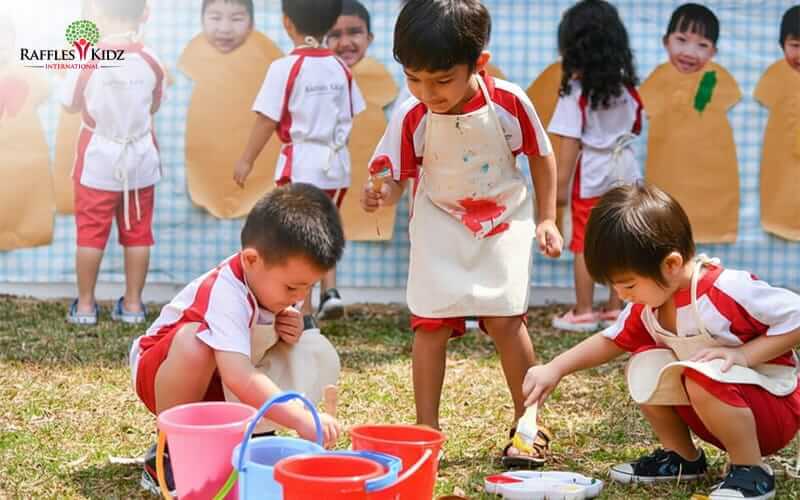
Our curriculum draws from Montessori principles and inquiry-based learning, creating a balanced environment where independence is nurtured alongside structured teacher guidance. This allows children to explore, ask questions, work with purposeful materials, and build confidence through active participation.
Children engage in hands-on activities, follow consistent routines, and are encouraged to express ideas through guided questioning and discussion. These carefully integrated teaching approaches support academic readiness, emotional confidence, social development, and a positive attitude towards learning.
This balanced model is especially helpful for parents seeking Montessori learning in Singapore with meaningful structure, because it brings together independence, inquiry, bilingual exposure, and teacher support within one cohesive preschool experience.
4.2. Bilingual Learn Integrated Across the Curriculuming
At Raffles Kidz International, bilingual learning is not treated as a separate component but woven into daily experiences.
Each classroom is supported by both an English-speaking and a Mandarin-speaking teacher, ensuring consistent exposure throughout the day. This dual-teacher model allows language learning to happen naturally through lessons, routines, conversations, art, movement, thematic learning, and social interaction.
English is used during English and Mathematics lessons, while Mandarin is integrated into meaningful daily activities. This helps children develop confidence in both languages through real-life use rather than rote memorisation.
For parents exploring a Chinese-immersion preschool, this approach provides consistent bilingual exposure in a structured and nurturing environment. It also shows how different teaching approaches can extend beyond pedagogy into language development, confidence, and communication.
4.3. A Structured Yet Responsive Learning Environment
The environment at Raffles Kidz International reflects careful attention to both structure and flexibility. While many of our centres adopt open-concept learning spaces, the classrooms are purposefully organised to support focus, movement, interaction, and exploration throughout the day.
Open-concept environments allow children to experience a more connected and collaborative preschool setting. At the same time, clearly defined learning corners, purposeful routines, and teacher guidance help children understand where activities take place and how to move through the day with confidence.
Outdoor discovery zones, purposeful learning corners, and dedicated activity areas provide opportunities for exploration while complementing classroom routines. These learning environments and facilities help children move between focused learning, social interaction, hands-on exploration, and active play in a balanced way.
Teacher guidance is also an important part of the experience. Educators observe children closely, ask questions, extend their thinking, and step in when support is needed. These teacher-child interaction patterns help children build independence while still feeling safe and supported.
Taken together, these features make Raffles Kidz International a strong option for families seeking a balanced bilingual preschool environment with thoughtful teaching approaches in Singapore.
Frequently Asked Questions
How do I know if a teaching approach suits my child?
Observing your child during a school visit can offer valuable insight into how they respond to different teaching approaches. Notice whether your child appears comfortable, curious, and willing to engage with the environment. Some children respond better to structured routines, while others are more confident in exploratory settings.
Parents should also observe how teachers guide children. Do they explain calmly? Do they ask thoughtful questions? Do they give children time to respond? Do they support children who are hesitant or unsure? These teacher-child interaction patterns often reveal whether the approach is suitable for your child.
Over time, the right approach often shows through a child’s willingness to participate, try new activities, communicate with teachers, and return to school with confidence.
Are blended approaches better than single-method programmes?
Blended programmes can offer greater flexibility, as they allow schools to draw from different teaching approaches to meet varied developmental needs. Instead of relying on a single method, educators can adjust their strategies depending on the activity, the learning objective, and the child’s readiness. However, the effectiveness depends on how well these approaches are integrated. A thoughtfully implemented blended curriculum tends to feel cohesive, rather than fragmented.
How important is bilingual exposure at the preschool level?
Bilingual exposure plays a significant role in early language development, especially in Singapore. When children are exposed to both languages consistently and meaningfully, they are more likely to develop confidence and comprehension over time. This is particularly effective when language use is integrated into daily activities rather than limited to formal lessons, allowing children to understand and apply language naturally.
Do facilities affect learning outcomes?
Yes. Learning environments and facilities can affect children’s behaviour, focus, confidence, and engagement. Calm, organised spaces with clearly defined learning areas help children settle into tasks more easily.
When visiting a school, observe noise levels, how materials are displayed, whether children can access learning resources independently, and whether there are spaces for reading, movement, outdoor play, and group interaction.
For open-concept preschool environments, parents should also observe how the space is managed. A well-planned open-concept setting should still feel purposeful, with clear learning corners, consistent routines, and teacher guidance that helps children stay focused while enjoying opportunities for interaction and exploration.
A well-designed environment should support the school’s teaching approach. For example, Montessori-based learning approaches require purposeful materials and orderly spaces, while inquiry-based learning benefits from areas that encourage exploration, questioning, and hands-on discovery.
Which teaching approach is best for preschool children?
There is no single best teaching approach for every child. Some children benefit from structured routines, while others thrive through exploration, discussion, and hands-on discovery. For many preschoolers, a balanced approach that combines structure, independence, teacher guidance, and meaningful play can support confidence, curiosity, and school readiness.
Conclusion
Choosing a preschool is one of the most significant decisions parents make during the early years. While curriculum labels can be helpful, they do not tell the full story. The right preschool is not simply the one with the most impressive description, but the one where your child feels safe, curious, supported, and genuinely excited to learn.
Understanding different teaching approaches helps parents look beyond marketing terms and focus on what happens in the classroom each day. The strongest preschools bring together thoughtful curriculum design, meaningful teacher guidance, suitable classroom pacing and learning progression, purposeful learning environments and facilities, and positive teacher-child interaction patterns.
At Raffles Kidz International, these elements come together through a carefully designed programme that combines Montessori principles, inquiry-based learning, bilingual immersion, small class sizes, and a structured yet responsive learning environment. This balanced approach supports independence, language confidence, emotional security, and academic readiness.
Choosing the right preschool becomes easier when you see how teaching approaches come to life in the classroom. Book a personalised tour at Raffles Kidz International to see how our Montessori-inspired, inquiry-based, and bilingual learning environment supports your child’s confidence, independence, communication skills, and love for learning.