
Introduction
Many parents in Singapore choose Montessori expecting independence and confidence, only to later realise that not all Montessori classrooms operate the way they imagined.
Montessori is one of the most recognised preschool approaches among Singapore parents, yet it is also one of the most misunderstood. Many parents associate Montessori with wooden materials and free choice, but are often surprised to find that classrooms today look more structured, guided, and aligned with school readiness expectations. This gap between perception and actual classroom practice is often where confusion and misplaced expectations begin
Many parents recognise the term but notice that Montessori can be practised differently from one preschool to another. In practice, not all Montessori-labelled programmes deliver the same experience, and this is where many parents get caught off guard. Some follow a traditional interpretation closely, while others adopt selected elements without fully applying the methodology. This variation can create uncertainty for families who want clarity about how daily routines, language use, and classroom expectations will actually unfold for their child.
Over time, Montessori ideas have been thoughtfully adapted and combined with other teaching approaches to meet modern learning needs. In Singapore, where early education is shaped by bilingual expectations, clear daily flow within classrooms, and preparation for primary school, programmes often evolve to reflect these realities while retaining core child-centred principles.
Rather than viewing this as a departure from Montessori, it is more accurately an evolution, and in many cases a necessary one to meet Singapore’s educational expectations. In Singapore’s context, where bilingual learning and school readiness are key priorities, Montessori principles are now applied alongside structured routines and guided experiences, reflecting what children in Singapore actually need to thrive in formal schooling environments.
To understand Montessori today, it is helpful to look at how its foundational concepts are applied within Singapore’s early childhood education landscape, rather than relying solely on traditional or textbook definitions. By examining how philosophy translates into practice, parents can make more informed decisions about the learning environment that best supports their child.
Key Takeaways
- Montessori in Singapore has evolved beyond its traditional form, adapting to bilingual expectations, structured routines, and national curriculum guidelines while retaining its core principles of independence and purposeful learning.
- In a Montessori-aligned setting, the prepared environment is intentionally designed to support focus, self-regulation, and growing independence, particularly within full-day preschool programmes.
- Modern Montessori-aligned preschools in Singapore often blend independent learning with teacher-led lessons to ensure children are academically prepared for Primary 1.
- Parents can better evaluate a preschool by looking at how philosophy translates into daily routines, language use, classroom structure, and educator guidance, rather than relying on labels alone.
Understanding Montessori Beyond Its Traditional Definition

The Original Educational Intent Behind Montessori
1. Independence as a Developmental Foundation
To understand what Montessori is, it is important to begin with its original educational intent. Montessori was developed as a scientific approach to education that supports children’s natural development through structured materials, purposeful activity, and growing independence. Independence is seen as a developmental goal, not something children are expected to demonstrate immediately, a distinction that is often misunderstood by parents.
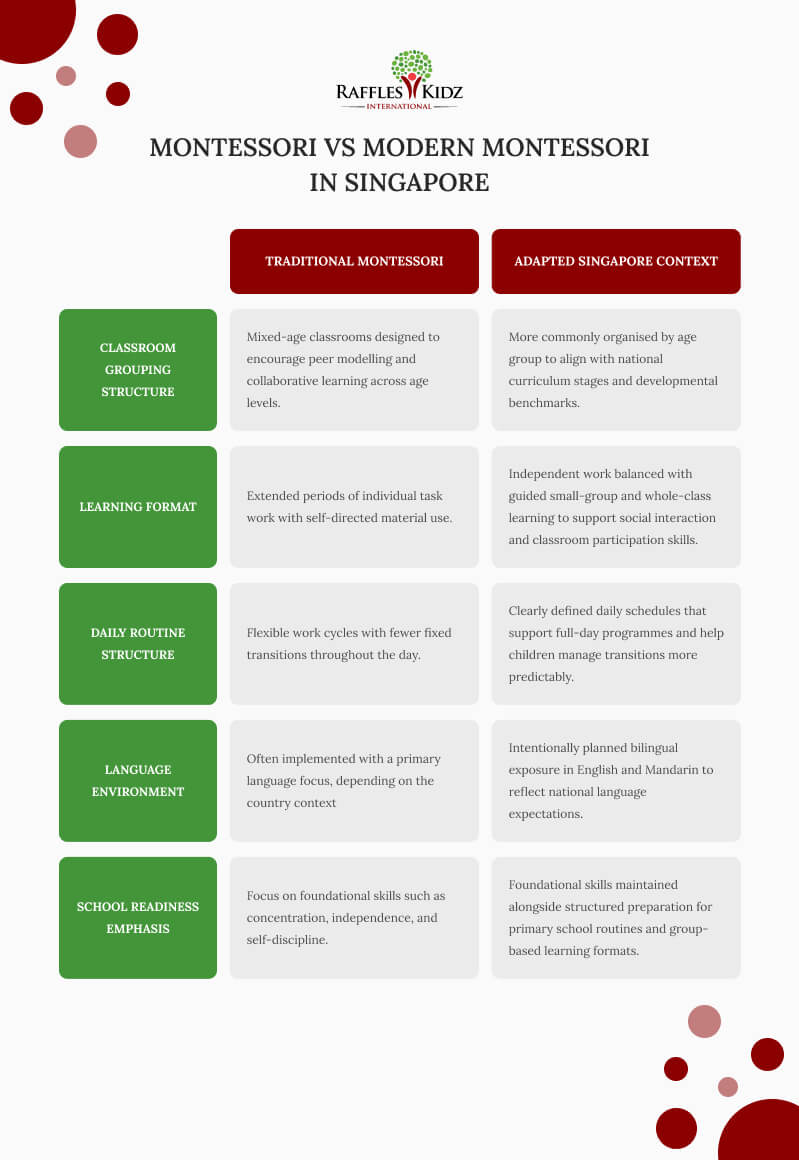
Core Montessori elements such as mixed-age groupings, carefully designed learning materials, and sensitive periods of development continue to influence how classrooms are structured today.
When parents explore what Montessori is, they often associate it with children choosing activities freely. In practice, independence is understood as something children grow into over time through everyday experiences such as making simple choices, staying focused on tasks, and taking responsibility for their actions within clear boundaries.
The emphasis is not on accelerating academic milestones prematurely, but on building the underlying skills that make academic learning sustainable. Instead, when examining what Montessori is, the core focus is on helping children build self-control, sustained attention, and confidence in solving problems. These foundational skills often influence how comfortably a child later adapts to more structured classroom settings.
2. The Prepared Environment as a Learning Framework
Another key aspect of Montessori is the concept of the “prepared environment”. Montessori classrooms were intentionally arranged to feel calm, organised, and easy for children to navigate independently. Furniture, materials, and routines were structured to reduce confusion and promote clarity.
Learning materials were placed in a deliberate sequence so children could progress from simpler tasks to more complex challenges at their own pace. This structured order is central to understanding what Montessori is, as it allows children to build mastery step by step and develop confidence through repeated practice before being introduced to more advanced tasks.
This environment supports independent engagement. Instead of constant verbal instructions, children interacted with materials designed to guide them through exploration. When parents ask what Montessori is, this self-directed interaction within a carefully designed space is often what differentiates it from more teacher-led classrooms.
3. The Educator’s Role as Observer and Developmental Guide
Another key aspect of what Montessori is relates to the educator’s role. Teachers were trained to observe closely, identifying each child’s readiness, interests, and developmental stage before offering guidance.
Support is provided thoughtfully and at the right moment, especially when a child shows signs of frustration or uncertainty. Rather than intervening immediately, educators allowed children time to attempt tasks independently, stepping in only when guidance would meaningfully support progress. This reflective approach is central to understanding what Montessori is beyond surface-level materials.
This role requires strong knowledge of child development. Teachers need to understand when to encourage persistence, when to offer assistance, and when to introduce new challenges. From the beginning, Montessori education depended on teachers making careful decisions based on their understanding of how children grow and learn.
Why Traditional Montessori Alone May Not Fully Reflect Today’s Preschool Context in Singapore
1. Changes in Family Life and Daily Routines
When trying to understand what Montessori is in Singapore today, it is important to recognise how family routines have evolved. Many children attend full-day programmes that support working parents, making preschools a significant part of a child’s daily structure.
Longer school days mean educational institutions play a wider role in supporting transitions, emotional regulation, rest periods, and sustained attention. Within the broader landscape of early childhood education in Singapore, programmes must account for children spending extended hours in structured environments.
As a result, classrooms in Singapore often incorporate clearer daily routines and more consistent group guidance, not to replace Montessori principles, but to ensure children remain engaged and able to function within longer full-day programmes. This adaptation does not replace Montessori principles, but reflects the practical realities of modern schooling in Singapore, including longer hours, structured routines, and clearer expectations.
2. Language Expectations in a Bilingual Society
Singapore’s bilingual framework also influences how Montessori is interpreted locally. Parents expect structured exposure to both English and Mother Tongue Languages, such as Chinese, Malay and Tamil, within a school setting, rather than relying on incidental exposure alone.
In many schools, this has led to more intentional language planning within a bilingual early learning environment, ensuring children receive consistent guidance in both languages during lessons and daily interactions.
For many families, how a school delivers its bilingual programme is just as important as the teaching approach. As a result, a Montessori-aligned preschool curriculum in Singapore may include more formal language instruction to ensure children are ready for the bilingual requirements of primary school.
3. Preparation for Singapore’s Primary School Environment
One of the most common concerns parents have is whether Montessori adequately prepares children for Singapore’s structured primary school system. Understanding what Montessori is within the Singapore context requires recognising parental concerns about school readiness.
Primary school in Singapore involves structured group instruction, routine participation, and the ability to follow multi-step directions. While Montessori emphasises independence, modern adaptations often include guided group experiences to ensure children become familiar with shared learning formats.
This balance plays a critical role in helping children transition more smoothly from kindergarten into Singapore’s structured primary school environment, where expectations around routines and group learning are significantly higher.
How Montessori Has Evolved in Today’s Early Childhood Settings
1. From a Fixed Method to a More Flexible Approach
Today, Montessori is often misunderstood as either overly rigid or completely unstructured, when in reality its effectiveness depends on how well its core principles are applied. In many modern classrooms, Montessori is no longer treated as a fixed method, but as a set of guiding principles that must be thoughtfully adapted to remain relevant in today’s educational landscape. Rather than strictly adhering to every traditional material or classroom structure, schools interpret core principles within current needs.
In many settings, including programmes serving children from pre–nursery levels onwards, educators integrate Montessori ideas into broader developmental frameworks that reflect current research and national standards.
2. Integrating Other Teaching Approaches Within Montessori-Aligned Practice
In Singapore, many high-quality preschools no longer rely on a single teaching method in isolation. Instead, they intentionally integrate Montessori principles within a broader framework that includes inquiry-based learning, structured language development, and guided group experiences. This blended approach allows children to explore concepts independently while also engaging in teacher-guided small-group activities, structured language sessions, and collaborative learning experiences that support social development.
Within this evolving framework, educators may pose questions, encourage children to explain their thinking, and connect activities to real-world contexts. Schools may also integrate thematic learning, planned bilingual instruction, and age-appropriate group routines alongside individual work cycles. This supports deeper understanding while maintaining clear expectations and routines.
For parents navigating childcare options in Singapore, recognising this integration helps clarify why Montessori classrooms today may include structured group lessons alongside independent work.
3. Should You Choose Montessori in Singapore? (And When It May Not Be the Best Fit)
Montessori can be highly effective when its principles are applied thoughtfully within Singapore’s context. However, it may not suit every child or align with every family’s expectations.
Montessori may be a good fit if:
- Your child benefits from developing independence at their own pace
- You value confidence, focus, and problem-solving over early academic drilling
- You are comfortable with a more gradual progression in structured academics
However, parents should also be aware that:
- A purely traditional Montessori approach without structured guidance may not fully prepare children for Singapore’s primary school expectations
- Bilingual development may require more intentional teaching than traditional Montessori typically provides
- Some children benefit from clearer routines and earlier teacher-led instruction
Understanding these differences helps parents make more informed decisions, not based on labels, but on how well a programme fits their child’s needs.
4. Balancing Individual Learning With Group Experiences
Modern classrooms aim to balance personal exploration with shared experiences. Children continue to engage in individual tasks, yet they also participate in group activities that build listening skills, turn-taking, and collaborative problem-solving.
This balance reflects a broader understanding of the Montessori learning approach within Singapore’s context. Self-directed learning remains valued, but it exists alongside social learning and guided interaction.
By viewing what Montessori is through this contemporary lens, parents can better understand how its foundational principles continue to influence classrooms today while adapting thoughtfully to Singapore’s bilingual, structured, and academically focused environment.
Montessori in Singapore’s Early Education Landscape
Why Montessori Remains Relevant in Singapore Today
1. How National Curriculum Direction Shapes Preschool Practice
In Singapore, many preschools are informed by the Ministry of Education’s Nurturing Early Learners (NEL) Framework, which sets broad guidance for holistic development. This includes building strong foundations in language and literacy, supporting social and emotional growth, and nurturing positive learning dispositions from a young age.
Because of this national framework, Montessori principles in Singapore are typically applied within a broader educational structure rather than followed as a completely standalone system. For parents asking what Montessori is in a local context, it is helpful to understand that schools are expected to align with national developmental goals while still maintaining their chosen educational philosophy.
This approach allows Montessori ideas such as independence, purposeful activity, and respect for individual development to remain relevant. At the same time, these ideas are adapted to local expectations around bilingual learning, structured routines, and readiness for primary school.
As a result, Montessori practice in Singapore reflects both philosophical roots and practical realities. It balances child-led exploration with clear guidance, ensuring that learning remains developmentally appropriate while aligned with national standards.
2. Learning Environments That Support Focus and a Sense of Security
In Singapore’s urban context, physical space plays an important role in supporting children’s focus. Some preschools use enclosed classroom layouts, which can help reduce distractions and create a quieter learning environment. This can be particularly helpful in busy neighbourhoods where surrounding activity may otherwise disrupt attention.
Clear classroom layouts and defined activity areas also help children understand where different types of learning take place. There may be specific spaces for quiet work, movement-based activities, collaborative tasks, and hands-on exploration. This organisation provides children with visual and spatial cues that support independence.
Such intentional setups help children feel settled and secure as they move through the day. When children understand where they are expected to be and what type of activity is happening in each space, transitions become smoother and behaviour expectations clearer. For parents exploring what Montessori is in a practical sense, the physical environment is often a visible reflection of how structure and independence work together.
3. Language Use in Bilingual Classroom Settings
In bilingual preschool environments, language exposure is usually structured rather than incidental. Activities may be conducted primarily in one language at a time so that children can follow instructions clearly and build understanding with confidence.
This structured approach is especially important for families considering a Chinese immersion preschool model. Rather than informal mixing of languages, teachers typically plan how and when each language is used to ensure balanced and meaningful exposure.
Consistent language planning supports children in developing listening skills, vocabulary, and confidence in both English and a Mother Tongue Language. Clear and predictable language use can help younger children follow instructions more comfortably as they build foundational language skills.
What To Look For In A Montessori-Aligned Classroom Today
1. Clear Structure Within Daily Classroom Routines
In a Montessori-aligned classroom, daily routines are generally consistent and predictable, even when children are given opportunities to work independently. A calm atmosphere often reflects careful planning rather than the absence of structure. For parents trying to understand what Montessori is in a real classroom setting, these predictable routines are an important indicator of how independence is supported within clear boundaries.
Children are guided by clear expectations regarding movement, use of materials, and how activities begin and end. This helps them understand boundaries while still allowing room for choice.
Over time, predictable routines help children develop self-regulation. They learn how to manage transitions, tidy up materials responsibly, and move between tasks with greater independence.
2. Educator Support Through Observation and Timely Guidance
Teachers in Montessori-aligned settings typically spend time observing how children engage with materials, interact with peers, and respond to challenges. Observation allows educators to understand each child’s developmental stage before offering guidance.
Support is provided thoughtfully when needed. For example, when a child appears unsure, distracted, or frustrated, the teacher may step in to offer clarification or encouragement rather than leaving the child to struggle alone.
This measured approach allows independence to develop gradually. Children receive help that matches their readiness level, ensuring that support strengthens confidence rather than replacing effort.
3. Planned Use of Language in Bilingual Classrooms
In Singapore preschool settings, bilingual learning is usually planned across different parts of the day. Teachers may designate specific activities or learning blocks for each language to ensure clarity.
Children may experience one language more consistently during certain sessions so that they can understand instructions fully and participate with confidence. This structure supports both comprehension and expressive ability.
Clear language planning reduces uncertainty and helps children feel secure in bilingual environments, especially during their early years of language acquisition.
4. Classroom Spaces That Support Focus and Comfort
Learning spaces are typically arranged to be visually clear and easy to navigate. Shelves, activity areas, and learning materials are organised so children know where to find and return items independently.
Defined areas for different activities help children understand what is expected in each part of the classroom. A reading corner signals quiet engagement, while a movement space supports physical exploration. For parents considering what Montessori is in practical terms, this intentional layout often reflects how independence and structure are designed into the environment itself.
This thoughtful arrangement is particularly valuable in full-day programmes. A calm, organised environment supports sustained attention and helps children manage their energy levels throughout the day.
Common Misunderstandings Parents May Have About Montessori
1. Montessori Is Unstructured
One of the most common misconceptions is that Montessori classrooms lack structure. In reality, well-implemented Montessori environments are highly structured, with clear routines, defined expectations, and carefully sequenced learning materials.
What may appear as freedom is actually guided independence within a well-prepared system.
2. Montessori Is Not Academically Supportive
Another frequent concern is that Montessori does not prepare children academically. This often stems from comparing it to worksheet-based or drill-focused programmes.
In practice, Montessori builds the underlying skills that academic success depends on, such as concentration, problem-solving, and the ability to follow multi-step instructions..
3. Montessori Is Outdated
Although Montessori was developed over a century ago, its core principles remain highly relevant. What has changed is how these principles are applied.
Modern Montessori-aligned programmes adapt to current educational expectations, including bilingual learning, structured routines, and preparation for formal schooling.
How Raffles Kidz International Applies Montessori Principles Today
At Raffles Kidz International, Montessori principles are applied in a way that reflects how children learn best in Singapore’s modern preschool environment.
Rather than following a purely traditional Montessori model, our classrooms are intentionally designed to combine independent exploration with clear structure and guided learning. This ensures that children develop confidence and self-direction, while also becoming comfortable with routines, group participation, and classroom expectations.
Our approach integrates Montessori-inspired independence with inquiry-based learning. Children are encouraged to explore, ask questions, and engage with materials purposefully, while teachers provide guidance to deepen understanding and maintain focus. This balance allows learning to remain child-centred, without becoming unstructured.
Bilingual development is a core part of the daily classroom experience. Both English-speaking and Mandarin-speaking teachers are present, with language use carefully planned across different parts of the day. This provides children with consistent exposure, helping them build confidence and clarity in both languages rather than relying on incidental language mixing.
In addition to core classroom learning, enrichment experiences such as speech and drama, creative expression, and hands-on activities are fully integrated into the regular programme, rather than offered as optional add-ons, ensuring all children benefit without additional cost to parents. These are not treated as optional add-ons, but as part of a holistic curriculum that supports communication skills, creativity, and confidence.
Class sizes are intentionally kept small to allow teachers to observe each child closely and provide timely, meaningful support. This ensures that independence develops progressively, with guidance that reflects each child’s readiness rather than a fixed pace.
Through this integrated approach, children experience a learning environment that is structured yet flexible, academically supportive yet developmentally appropriate, and designed to prepare them confidently for primary school and beyond.
Questions You Might Ask
1. Is Montessori Still Relevant for Children Growing Up in Singapore Today?
Montessori remains relevant when its principles are thoughtfully adapted to the realities of Singapore’s early education landscape. Children today grow up in dense urban environments, within bilingual settings, and under education systems that value both holistic development and academic readiness. When Montessori practices are applied with intention, they continue to support independence, concentration, and self-regulation while aligning with structured routines, language expectations, and social learning needs common in Singapore classrooms.
2. Does a Montessori Approach Help Children Transition More Smoothly to Primary School?
A Montessori-aligned approach can support a smoother transition to primary school by helping children become comfortable with routines, sustained attention, and working both independently and in groups. Rather than focusing on early academic drilling, this approach emphasises skills such as following instructions, managing simple responsibilities, and participating in structured activities. These everyday learning habits can help children adjust more confidently when they enter primary school, where expectations around routines, classroom behaviour, and group learning become more defined.
3. How Does Raffles Kidz International Balance Structure and Exploration?
At Raffles Kidz International, Montessori-inspired independence is integrated with inquiry-based guidance to create a balanced learning environment. Children are encouraged to explore and engage actively, while educators provide structure, observation, and scaffolding to support understanding. This balance allows curiosity to develop within clear learning goals, offering both freedom and consistency in daily learning experiences.
Conclusion

Ultimately, understanding what Montessori is today requires moving beyond labels and looking at how it is applied in practice. When parents ask what Montessori is, the answer is no longer limited to a traditional classroom model but includes how its principles are interpreted within modern educational contexts.
In Singapore, its continued relevance lies in how core ideas such as independence, routine, and respect for each child are applied within bilingual settings supported by defined learning expectations. These adaptations ensure that children are supported not only in developing confidence and focus, but also in building the language and social skills expected in local primary schools.
When Montessori-inspired practices are implemented thoughtfully alongside clear guidance and supportive environments, children can experience learning that feels purposeful, consistent, and developmentally appropriate. This balance allows independence to grow gradually within a framework that provides security and clarity.
In Singapore, the most effective programmes are not those that follow any single philosophy rigidly, but those that thoughtfully integrate strong educational principles with the realities of modern learning environments.
For parents, the key is not whether a preschool is “Montessori” in name, but whether it provides a balanced, structured, and developmentally appropriate experience that supports their child’s growth with clarity and purpose.
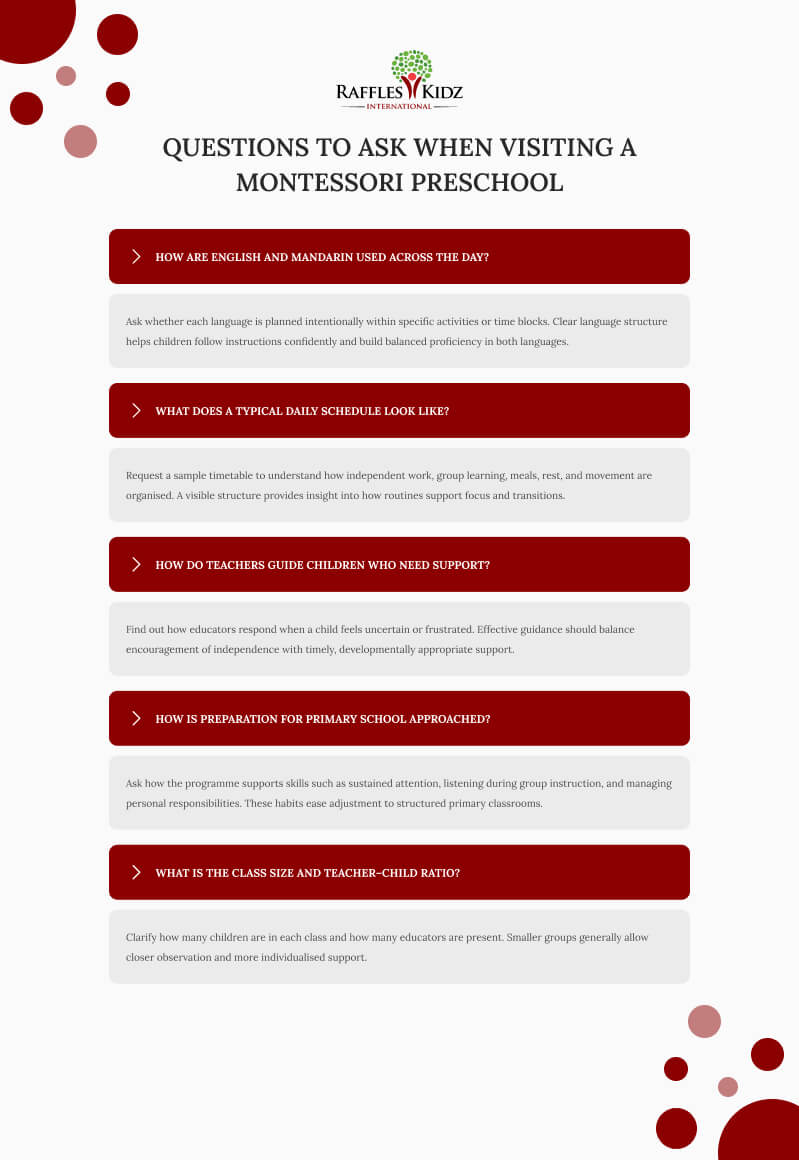
See how Montessori is applied in a real classroom setting. Book a personalised tour to observe how structure, bilingual learning, and independence are balanced in your child’s daily experience.