

Key Takeaways
- Preschools offer predictable routines and consistent guidance that help children feel secure and confident throughout the day.
- Emotional support from trained educators eases daily transitions and nurtures healthy social and behavioural development.
- Full-day programmes and holistic activities help families balance busy schedules while ensuring children continue learning meaningfully.
- Strong home–school communication builds trust and ensures each child receives personalised support aligned with their developmental needs.
Introduction
For many working parents in Singapore, childcare is not simply about supervision during office hours. It is about having a reliable support system that helps children feel safe, settled, and meaningfully engaged while parents manage work, commuting, and daily family responsibilities.
This is especially important for dual-income households, where weekday routines can be demanding. Parents often need more than basic care. They look for a preschool that provides consistent routines, clear communication, emotional support, and meaningful learning throughout the day.
While some childcare arrangements may address immediate supervision needs, a well-designed preschool can better support both a child’s development and the family’s daily routine. From structured full-day programmes and teacher consistency to bilingual exposure and integrated enrichment, the right preschool becomes a trusted partner for working families.
What Working Parents Actually Need From Childcare Support
When parents search for childcare support in Singapore, they are often trying to solve very specific daily challenges—not just find a place for their child to stay.
These include:
- Managing long work hours without disrupting their child’s routine
- Reducing the stress of multiple caregiving arrangements
- Ensuring their child is learning meaningfully, not just being supervised
- Staying informed and connected despite a busy schedule
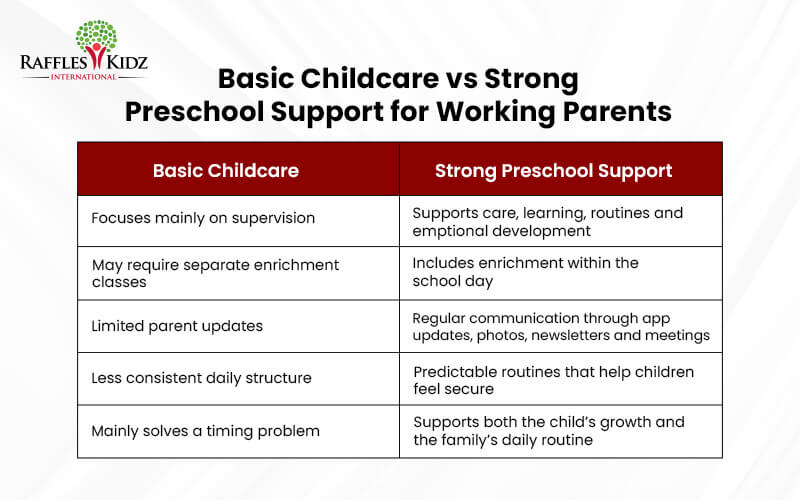
A preschool that truly supports working families addresses all these needs within a single, structured environment. This is where the difference between basic childcare and a well-designed preschool experience becomes clear.
Childcare Challenges Working Parents Face in Singapore
For many working parents in Singapore, childcare decisions are shaped by very practical daily realities. Long working hours, commuting time, last-minute work demands, and limited family support can make weekday routines stressful. For Singapore families, especially dual-income households, having a dependable preschool arrangement is often essential to maintaining better work life balance.
This is why childcare support for working parents should go beyond basic supervision. A suitable preschool should provide predictable routines, safe handover processes, consistent teacher communication, and purposeful learning throughout the day. When these areas are well managed, parents can focus on work with greater peace of mind, knowing their child is cared for, engaged, and supported in a stable environment.
The Growing Need for Reliable Childcare in Modern Families
Not all preschools provide the same level of structure, consistency, or practical support. For working parents, effective childcare support depends on how well a preschool integrates daily routines, learning experiences, teacher guidance, and communication into one dependable system.
A high-quality preschool should minimise disruption, provide continuity throughout the day, and ensure children are not just cared for, but actively engaged in meaningful development. This is especially important for families who rely on their child’s school to support both daily routines and long-term growth.
At Raffles Kidz International, our full-day programme is designed with working families in mind. Children follow a consistent daily routine that includes bilingual learning, Montessori-inspired exploration, inquiry-based activities, outdoor play, meals, rest time, and enrichment within school hours. By integrating these experiences into the regular programme, parents can enjoy a more convenient and well-rounded preschool experience without relying heavily on additional external classes or childcare arrangements.
Predictable Schedules to Support Busy Routines
Most preschools in Singapore operate full-day programmes (typically 7 am to 7 pm), giving parents practical flexibility to manage varying work hours without disrupting their child’s daily rhythm. A consistent schedule helps children understand what to expect, making transitions between activities more predictable and less overwhelming. Over time, children become more confident moving through their day independently, whether it is during play, learning, or daily routines. With guidance from both English and Mandarin-speaking teachers, these routines also support communication and social development in a structured, familiar environment.
Professional Supervision Backed by ECDA Standards
In Singapore, licensed preschools are regulated by the Early Childhood Development Agency (ECDA), which sets standards for areas such as safety, staff qualifications, programme quality, and teacher-to-child ratios. For working parents, this provides added reassurance that their child is cared for in a structured and well-regulated environment.
Beyond meeting regulatory requirements, parents should also consider how each preschool applies these standards in daily practice. This includes classroom supervision, teacher consistency, communication routines, and how children are supported during meals, rest, play, and learning time. These day-to-day details help families assess whether a preschool can provide reliable and consistent childcare support throughout the school day.
Smooth Morning Transitions for Working Families
Drop-off routines often align naturally with office hours, enabling parents to begin their workday with a clearer focus, knowing their child is settling into a familiar environment. Regular routines help children become more comfortable with separation, especially when they know what to expect each morning. Teachers play an important role in easing this transition by engaging children in activities and conversations, helping them settle in more quickly. This dependable rhythm, supported by familiar educators and consistent communication, helps make weekday mornings calmer and strengthens the overall childcare support for working parents.
How Preschools Provide Consistency and Emotional Stability
Children thrive when they feel secure, understood, and supported. Preschools help build this emotional stability through predictable routines, responsive teacher relationships, and environments designed around young children’s developmental needs. This is particularly important for families exploring preschool choices in Singapore, where nurturing care is a top priority.
Trusted Bonds with Familiar Teachers
Stable teaching teams help children form secure attachments, reducing separation anxiety and strengthening confidence during daily transitions. With familiar educators guiding them each day, children are more likely to feel safe, understood, and ready to participate in classroom activities. This consistency also supports smoother drop-offs, as children develop trust in their teachers and adapt more comfortably to time away from home. Over time, these relationships encourage independence while giving parents added reassurance during busy workdays.
Daily Rhythms That Build Independence
Circle time, outdoor play, meals, and rest follow predictable patterns that help children understand what to expect throughout the day. With consistent routines in place, children gradually learn to manage simple tasks on their own, such as transitioning between activities, following instructions, and participating more confidently in group settings. Over time, this sense of familiarity supports the development of independence, as children become more comfortable making small decisions within a structured environment. Guided by their familiar teachers, these daily rhythms also reinforce communication and social skills, making weekday transitions smoother for both parents and children.
Supportive Responses to Big Emotions
Early childhood educators support children in understanding and expressing their feelings in a calm and reassuring way. When children feel upset or frustrated, teachers guide them step by step, helping them learn how to manage their emotions and respond more confidently in different situations. With support from their teachers, children gradually develop the ability to communicate their needs clearly and build stronger relationships with others. This consistent guidance not only supports emotional well-being in the classroom but also strengthens the overall childcare support for working parents, especially during busy or challenging weeks.
Supporting Work–Life Balance Through Structured Care

For many Singapore families, a well-structured full-day preschool programme can help support better work life balance by providing children with a consistent environment to learn, play, rest, and develop throughout the day while parents focus on work and daily responsibilities.
At Raffles Kidz International, our full-day programmes are designed to provide both meaningful learning and dependable childcare support. Children experience bilingual immersion, Montessori-inspired learning, inquiry-based exploration, enrichment activities, meals, rest time, and guided daily routines within a single structured programme.
This integrated approach helps reduce the need for multiple after-school arrangements or separate enrichment classes, while ensuring children continue to receive consistent academic, social, and emotional development in a familiar and supportive environment.
Full-Day Programmes that Maximise Learning Opportunities
Rather than relying on multiple childcare arrangements, full-day preschools offer integrated learning, enrichment, outdoor play, and rest periods all within the same environment. This provides continuity and reduces additional scheduling demands for dual-income families.
Practical Continuity for Dual-Income Families
For dual-income households, practical continuity matters. When core learning, enrichment, outdoor play, meals, and rest are all managed within the preschool day, parents do not need to coordinate multiple pick-ups, external classes, or separate caregiving arrangements. This creates smoother weekday routines and provides stronger preschool support for dual-income households.
Reliable Communication Channels for Parents
Clear and consistent communication plays an important role in childcare support for working parents. Regular updates, photos, classroom observations, and progress sharing help parents stay connected to their child’s development even during busy workdays.
At Raffles Kidz International, parents receive updates through our mobile app, Commbook, along with weekly class photos, monthly newsletters from both English and Chinese teachers, and twice-yearly Parent-Teacher Meetings. These touchpoints provide parents with better visibility into their child’s learning, daily routines, and overall development.
The Educational Edge: Learning Beyond Supervision
Preschools today go beyond basic care, offering structured environments where learning is woven into daily activities. Children build key skills in language, numeracy, and social interaction through purposeful play and guided experiences, giving working parents confidence that their child is learning and growing meaningfully.
Different Teaching Approaches for Every Learner
Preschools in Singapore offer a variety of teaching approaches, including Montessori, inquiry-based, play-based, and Reggio Emilia-inspired frameworks. For working parents, what matters most is how effectively the curriculum supports their child’s learning and development throughout the school day.
At Raffles Kidz International, our preschool curriculum combines Montessori-inspired learning with inquiry-based exploration to nurture independence, curiosity, problem-solving, and confidence. Children are encouraged to learn actively while developing communication skills, social awareness, and a love for learning from an early age.
Language Exposure Throughout the School Day
Language development is most effective when children are exposed to it naturally and consistently. Throughout the school day, children build communication skills through stories, songs, conversations, classroom routines, and interactions with teachers and peers.
At Raffles Kidz International, our bilingual environment gives children regular exposure to both English and Mandarin. This helps children become more comfortable listening, speaking, and expressing themselves in different contexts. Over time, daily bilingual exposure supports confidence, social development, and stronger preparation for primary school.
Environments Built for Active Learning
Beyond mere supervision, a purposeful preschool environment acts as vital childcare support for working parents by fostering active discovery. Learning corners and outdoor zones allow children to investigate at their own pace, ensuring a full day of growth and engagement. This thoughtful design balances structure with play, giving families confidence that their child is thriving in a stimulating setting.
A Trusted Partnership Between Parents and Preschools
A strong preschool–parent partnership helps children feel anchored both at home and school. For families considering a preschool in Singapore, other than a suitable curriculum, clear communication, personalised support, and aligned goals between teachers and parents are often a top priority.
Open Communication to Support Every Child’s Progress
Preschools regularly share milestones, observations, and developmental updates. This transparency helps parents make informed decisions and remain meaningfully involved despite demanding work schedules. It also helps new parents feel more at ease while working, making preschool transitions smoother for both parents and children.
Personalised Attention for Diverse Family Needs
When parents are balancing demanding work schedules, teachers step in to become a consistent source of support, from easing drop-off anxiety to reinforcing routines at home. This practical day-to-day guidance helps busy parents remain meaningfully involved in their child’s development despite the pressures of a full working week.
Shared Goals for a Consistent Home–School Experience
When parents and teachers reinforce similar expectations, children gain stability and confidence, strengthening overall developmental outcomes. Schools often hold parent-teacher meetings to align goals, using these sessions to discuss developmental milestones, address any specific behavioural or learning challenges, and collaboratively set supportive routines that bridge the school and home environments.
How to Choose the Right Preschool for Working Families
When evaluating childcare support options, working parents should look beyond basic facilities and consider how well a preschool supports both daily family routines and meaningful child development.
Key factors to look for include:
- Full-day programme structures that align with working hours
- Consistent teaching teams that provide emotional stability
- Bilingual exposure throughout the school day
- Integrated enrichment within school hours
- Clear parent communication systems
- Safe and structured routines for meals, rest, play, and learning
- A curriculum that supports independence, confidence, and school readiness
Together, these elements create a dependable environment that supports both the child and the parent. For busy families, the right preschool can help ease weekday routines, reduce stress, and provide greater confidence in their child’s overall development.
Conclusion

Supporting modern families involves more than providing supervision. It requires structured routines, meaningful learning experiences, emotional support, and responsive communication. In Singapore’s fast-paced environment, dependable childcare support for working parents plays an important role in helping families maintain stability throughout the week.
At Raffles Kidz International, we strengthen this support system through full-day programmes that integrate bilingual immersion, Montessori-inspired learning, inquiry-based exploration, hands-on activities, and child-centred routines directly into the school day. Our smaller class ratios, trained educators, and thoughtfully designed learning spaces help children feel secure, engaged, and confident.
We also place strong emphasis on parent communication. Through our mobile app, Commbook, weekly class photos, monthly newsletters from English and Chinese teachers, and twice-yearly Parent-Teacher Meetings, parents are kept informed about their child’s progress, routines, and classroom experiences.
Choosing the right preschool can make weekday routines smoother for both children and parents. If you are looking for childcare support for working parents in Singapore, visit Raffles Kidz International to see how our full-day programme, bilingual environment, integrated enrichment, and consistent communication support busy families in a real classroom setting. Book a personalised tour and discover how your child can enjoy a structured, engaging, and well-supported school day while you manage work with greater peace of mind.